Posts Tagged ‘Robert Bruce’

How do the Davids of history fight the ever-present Goliaths?  Sometimes, a well-aimed stone and a bit of luck (or God’s help) does the job.  In the case of Robert the Bruce and the small country of Scotland, standing up to the might of England, with a much larger population, bigger horses, better-equipped knights, stones might not quite do the job.

Bruce did have one piece of luck on his side: Edward I was not his father.  He was not the knight, king, or commander his father had been.  He was not liked or respected by his people.  Some sources, not worrying about his feelings overly, say he ‘lacked the dignity’ of his father, and ‘failed miserably’ as a king.  His lavish spending, including on male favorites such as Piers Gaveston, made him unpopular with the lords.  This, and other issues led to the baronial revolt, and of course, it was easier for Bruce to re-take his country with the invaders pre-occupied with fighting amongst themselves.

Despite this, Bannockburn was still a pitched battle–something the Bruce had done his best to avoid throughout his years fighting England, and for good reason.  The English routinely had much larger forces, and guerrilla warfare gave the Scots a fighting chance (no pun intended–well, maybe not).   But faced with two forces meeting face to face on open field, Bruce found other methods.

The first of his strategies in defeating an army rumored to be anywhere from three to five times larger than his own, was to get there first and choose his ground.  Bruce had long been a master of this, in battles which will be discussed later.  Bannockburn was no exception.  He knew the road the English must take to reach Stirling Castle.  Remember, Bannockburn stemmed from the agreement between de Mowbray, the commander of Stirling Castle, and Edward Bruce, that de Mowbray would turn Stirling over to the Scots if Edward II did not send reinforcements by Midsummer’s Day.  This is what Edward II was attempting to do, and what Robert Bruce and the Scots were trying to prevent.  With that destination in mind, Edward’s mighty army, his 2,500 warhorses, 500 light cavalry, 2,000 Welsh bowmen, and tens of thousands of foot soldiers, marched up the old Roman road.

 The Roman road ran, at one point, between woods (The New Park) on the west and a bog (the Carse) on the east.  The deadliest part of England’s army was its cavalry.  But everybody has their Achille’s heel.  Even a highly trained knight armed with deadly weapons, atop a charging warhorse.  The one thing such a knight on his warhorse really needs is firm ground to support the weight.  And at this stretch of the old Roman road, there was very little of that.  By arriving first and staking out this section, Bruce created a situation in which 1) only a small part of the 20 mile long army could come through at any given time and 2) those that strayed from the solid path, or were forced to fight beyond it, would have one of their greatest assets–size and weight–turned against them, as they found themselves mired in the boggy ground.

Bruce did not rise to power in Scotland, however, by relying only on what the landscape gave him.  He came early, and did not sit idle while he waited.  In the weeks before England arrived, he set his men to digging ‘murder pits’ all over the carse across which the English would charge.  These pits were deep, and filled with spikes sticking straight up.  The pits were covered over with a camouflage layer of branches and leaves culled from the New Park wood.  Normally, I’d have to say that’s not very nice.  But then again, if I knew a knight was going to be charging at me swinging a mace and sword to crush in my skull, I think I’d do the same thing. 

Bruce had used this strategy in previous battles.  Nigel Tranter novelized the results in The Path of the Hero King.  The first wave of cavalry hit the first row of murder pits and went down.  The knights behind them were unable to stop, their horses simply not being so agile.  Eventually, enough horses had gone down in these pits that further waves were able to simply ride over the bodies.  They did not count on there being a second row of murder pits.  Or a third.

For those horses who escaped the murder pits, Bruce had another surprise: caltrops.  A caltrop is a giant, four-armed jack.  No matter which way it lands on the ground, a spike is sticking straight up, waiting to pierce a hoof.  If your name is Drummond, they may be part of your family history, as Sir Malcolm de Drymen is credited with strewing them on the ground that day.  It is said that the caltrop on the Drummond arms, and the motto Gang warily stem from this moment in history.

For those cavalry who survived both murder pits and caltrops, Bruce had his schiltrons waiting.  Those who saw Braveheart will likely remember the scene in which the Scots wait, with 15 foot pikes flat on the ground, until it is too late for the charging English cavalry to stop.  The pikes come up, and the charging horses impale themselves, and sometimes their riders, on the pikes. 

The drawback to this method was that it was purely defensive.  Bruce shortened the pikes to a more manageable length and trained his men to march together, hundreds together, with pikes pointed outward, thus making the schiltron a mobile, offensive force, the only power in the world that could take on mounted cavalry.  Bruce had six schiltrons at Bannockburn. 

One of the more famous stories to come out of the battle is that of Sir Robert Clifford and his 700 English cavalry attacking a schiltron.  He succeeded in getting himself and a large number of his knights killed or captured.  (One of these was Sir Thomas Gray, whose son later gave us one of the few written records of the battle based on first hand accounts.)  The rest scattered, realizing the futility of the attempt.

Knowing from past experience that the archers were a danger to his strongest weapon, the schiltrons, Bruce dispatched Keith’s cavalry to deal with them.

Bruce’s plans and choice of battleground not only destroyed much of the English cavalry before they could even begin to fight, but prevented tens of thousands of footmen from ever fighting at all.  Because of the narrow entry through which they must come, these soldiers were trapped behind the knights, and unable to fight. 

Finally, there is the storming from Coxet Hill (or Gillies, according to some).  Some say it was the Knights Templar.  Others say it was Bruce’s reserve army, and still others that it was the ‘wee folk,’ or townfolk, racing to battle with their homemade weapons and farming tools, waving blankets and homemade banners on poles, and thus appearing to the English to be another army. 

 The English had gone into the main battle already demoralized.  The destruction of their archers by Keith’s light cavalry and the apparent appearance of a fresh army were the final blows.  Edward II, with a host of his followers, turned and ran.  In the chaos that followed, many of the English drowned trying to cross back over the many waterways–the River Forth, the Pelstream, and the Bannock Burn–which hemmed them in.

Sources contradict one another, and arguments rage as to how many fought on each side at the battle of Bannockburn.  (The number I’ve given above are only one source, and vary widely in others.)  But what is undeniably true is that the Scottish forces were heavily outnumbered, at least three to one, and some say as much as five to one.  And yet, with the foresight of Robert the Bruce and his years of creative warfare against a much stronger army, they were able to not only win, but completely rout their Goliath.

One of the difficulties of researching medieval times is that of repetitive names, and people with a multitude of names.  In medieval Scotland, there are an abundance of Williams, Alexanders, and Roberts.  Even adding last names doesn’t always help. 

Take the name John Comyn.  In the time of Robert Bruce, alone, there are several of them important enough to have come down in history.  The best known is the John Comyn, Guardian of Scotland, slain by Bruce before the altar of Greyfriars Kirk.  That John Comyn is also known as John III Comyn, Lord of Badenoch, and the Red Comyn. 

His father, John II Comyn, also Lord of Badenoch, also a Guardian of Scotland at one stage, was the Black Comyn,  and, like his son, fought for the crown of Scotland with a Robert Bruce–although with Robert Bruce’s grandfather,also Robert Bruce,  known as “The Competitor,” in the late 1200’s, whereas John III, the Red Comyn, fought with the younger Robert Bruce, of Braveheart and Bannockburn fame.

Home of the Comyn Family

Home of the Comyn Family

Current with this John Comyn was his cousin, John Comyn, differentiated by  the title Earl of Buchan.  In an interesting, perhaps sad, twist, this John Comyn, Earl of Buchan, though a great supporter of John Baliol and enemy of Robert Bruce, was also the husband of the remarkable Isobel MacDuff, Countess of Buchan, who left her husband to ride north and claim the MacDuff family’s traditional role of crowning the Kings of Scotland, by placing the crown on Robert Bruce’s head, shortly after he murdered her husband’s cousin, John Comyn, at Greyfriars Kirk.

Confused yet?

Actually, writing it all out has made it all much clearer.  Now for my second act… on to the Alexander Comyns and Alexander MacDougalls!

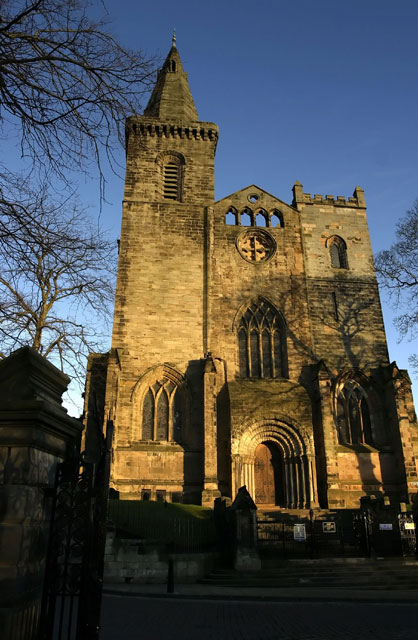
February 10 is the day Robert Bruce killed John Comyn in front of the altar of Greyfriars Kirk in Dumfries, in 1306.  The two families, Bruces and Comyns, had long been at odds over the throne of Scotland, and in the days after John Baliol’s failed kingship, the rivalry renewed.  Bruce and John Comyn agreed to meet at Greyfriars to discuss matters. 

Whether Bruce went with the intention of killing Comyn, or whether the crime was committed in the heat of an argument is unknown, but the end result is remembered 700 years later: Robert the Bruce, Scotland’s greatest king, killed a man in front of an altar on holy ground.  The deed launched him on a more abrupt road to kingship and war with England than he most likely intended.

Killing was not an unusual matter in medieval life.  Killing a man on holy ground, however, was a serious matter.  Bruce knew that he would be ex-communicated for it, and, more importantly, that an ex-communicated man cannot be crowned king.  His answer was the race to Scone, where he was crowned before the Pope could get the news and proceed with the ex-communication.

The killing at Greyfriars also cemented some of the great families of Scotland against Bruce as king, and leading them to side with England in the years leading up to Bannockburn.  Who’s to say what would have happened, had tempers stayed cool at Greyfriars that day.  Would Scotland have had an easier time, had the Comyns and their kin not turned against Bruce?  Or would Scotland have had a harder time, with continued infighting amongst the clans?  Regardless, the incident stands out as a major event in the life of Robert Bruce and the history of Scotland.

More on John Comyn tomorrow.

For some background information on this article, it is important to know that Bruce lived from 1274 until 1329,  200 years before Martin Luther’s 95 Theses and before Henry VIII made his split from the Catholic Church.  In other words, in his day to be Christian was to be Catholic.

And Bruce himself seems to have been a rather devout Catholic.  He counted among his close friends and associates Bishops Lamberton and Wishart, and Bernard de Linton, Abbot of Arbroath.  He carried the relics of both St. Columba and St. Fillan to the Battle of Bannockburn in June of 1314.   And on the morning of the main battle, Bruce started the day with Mass, his army of thousands on its knees before Maurice, the blind and barefoot abbot of Inchaffray, not only saying Mass, but receiving absolution.  The Declaration of Arbroath, sent to the Pope in 1320, compares Bruce to the Biblical figures of Joshua and Judas Maccabeus, who led their people against oppressors.  One of his unfulfilled dreams was to go on a Crusade.  Such was his wish that, though he was unable to fulfill it himself, he exhorted a promise from his closest friend, James Douglas, that, after Bruce’s death, James would take his, Bruce’s, heart on Crusade.  This James Douglas did, carrying Bruce’s heart in a silver casket. 

As to excommunication, it is a formal declaration of exclusion from the community, and within the Catholic Church typically means one is no longer allowed to partake of communion. 

For a devout Catholic, Robert Bruce had a bad knack for getting ex-communicated.  It started with the murder of John Comyn, the Red Comyn, Lord of Badenoch (yes, these were all the same man– just to be clear which of several John Comyns we’re talking about) before the altar of Greyfriars Church in 1306.  In Blue Bells of Scotland, Shawn expresses disbelief that a man should be excommunicated for killing, as it seems, to him, to be the national pastime of medieval Scotland.  And it is true that the real issue was not so much the killing, as the killing of a man on holy ground.

The thing to remember about excommunication is that it’s like drenched.  You can’t get more drenched, and you can’t get more excommunicated.  Unlike drenchings, though, excommunication does not ‘dry out.’  You remain so until it is formally lifted.  And this is why it’s an almost amusing story, that in 1317, with the former excommunication never having been lifted, and no more severe penalties to inflict, Pope John XXII once again excommunicated Bruce.  This time, however, he applied the punishment to all of Bruce’s associates, the whole of Scotland, really, and furthermore, declared that the prelates of York and London were to repeat the excommunication ceremony every single Sunday and every holy day for a whole year.  As if a drenched man might become even more drenched.

Interestingly, many sources credit the Pope’s ridiculous order as the inspiration for the Scottish nobles writing the Declaration of Arbroath, Scotland’s most famous document on a par with, and many say largely the basis for, our own Declaration of Independence. 

I wonder how Bruce or his comrades felt about all of this.  I suspect that they were strong enough in their faith in the rightness of their cause, declaring the independence that had always been theirs before Edward Longshanks invaded,  that it was little more than a source of amusement to them, although I would think it might also have saddened them, to be on the wrong side of a faith and church that they obviously valued.

Isabel MacDuff did not much care for her lodgings at Berwick Castle. 

Isabel MacDuff

Isabel MacDuff

Isabel MacDuff is a woman who deserves more attention than she has gotten, at least on this side of the Atlantic.  Although a minor player in history, her courage, strength, and patriotism put her on a level withthe greats.   Her story officially begins withher birthin 1286, within months of the fateful death of Alexander III, which threw Scotland into such turmoil.  Thus, she would have grown up in the days of upheaval, of Edward Longshanks, Hammer of the Scots’ invasions of Scotland, through the days of the Guardianship– her father, Duncan MacDuff, was one of the Guardians– and John Baliol’s failed kingship, through the events of William Wallace’s uprisings against England.

In an explanation of the events to follow, it is important to know that the MacDuff clan held a hereditary right to crown the Kings of Scotland.  In a more direct explanation of Isabel’s Scottish patriotism, her mother, widowed when Isabel was about three, re-married one Sir Gervase Avenel, who gave his fealty to Robert the Bruce early on. 

What complicated matters for Isabel, and tested her determination and courage, was the fact that her brother was growing up as a ward fo the English court, perhaps even as a companion of the young Edward II.  Moreover, in 1306, aged 19 or 20, Isabel married John Comyn, Earl of Buchan.  John Comyn was a supporter of John Baliol and enemy of Robert Bruce.  It was John’s cousin, also John Comyn, but Earl of Badenoch, whom Robert Bruce stabbed to death before the altar of Greyfriars Church in Dumfries on February 10, 1306, cementing the Comyn family’s hatred of Bruce.

This incident, perhaps, changed Isabel’s life.

Bruce, knowing  he would be excommunicated for killing a man on holy ground, and knowing an excommunicated man could not be crowned king, did the only sensible thing in a time without e-mail: he dashed for Scone, the traditional crowning place of the Scottish kings, in a race against the messengers flying to the Pope with news of the Greyfriarsmurder and the messengers speeding back equally hastily with news of his excommunication.

Isabel, however she heard the news of Bruce’s flight to Scone for coronation, determined that, as her young brother was in England, unable to claim the MacDuff family’s right, she would do so herself, against the obvious wishes of her new husband.  One story says she stole her husband’s horses.  Other sources say that, as Lord John was in England at the time, there was no need for deception, and she merely rode off.  The first story is more interesting, though perhaps less accurate.

Isabel Crowns Bruce

Isabel Crowns Bruce

Despite her best efforts, Isabel actually arrived in Scone the day after Bruce’s coronation.  However, her efforts meant a great deal to him.  He’d already been deprived, by Edward I, of the traditional coronation stone, the Stone of Scone (which contrary to appearances does not rhyme: it’s pronounced scoon).  Without the traditional elements of coronation, the Stone and a MacDuff to crown him, he worried that his kingship would be viewed as less than completely legitimate.  Therefore, the coronation ceremony was re-enacted on the 25th of March, 1306, when Isabel MacDuff, Countess of Buchan, set the crown on the head of Robert the Bruce, making him (for the second time in two days) King of Scotland.

(Just to be as accurate as possible, other sources put the re-crowning on March 27, 1306.)

Having no future withher husband after this act, Isabel stayed on with the Bruce’s.  However, Scotland was a country under attack.  Bruce was a man very badly wanted by Edward, and not well liked by the vast reaches of Clan Comyn and their allies, either.  In July 1306, he sent his wife, sisters, daughter, and Isabel to Kildrummy Castle for safety, under the protection of his brother Nigel (or Neil as he was also known).

Unfortunately, Bruce had many enemies.  Kildrummy was attacked in September of 1306.  Though the women escaped the castle, they were captured by William, Earl of Ross, while fleeing north, and taken to Edward Longshanksin England.  Bruce’s wife, Elizabeth, was treated perhaps the most kindly, the fortunate result of her also being the daughter of Edward’s ally, the Earl of Ulster.  But Bruce’s ten year old daughter, Marjory, was from his first marriage, and therefore no concern to Edward; she was incarcerated at Watton Priory.  His sister, Christina, was locked in a nunnery for years.   Nigel met the most unpleasant face, being publicly tortured and executed in most barbaric fashion by Edward I.

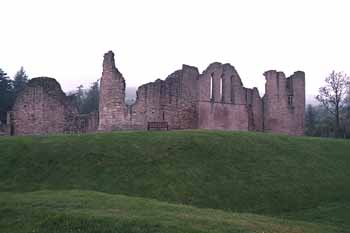
Remains of Berwick Castle

Remains of Berwick Castle

Bruce’s other sister, Mary, received more of Edward’s wrath.  She and Isabel were both ordered by Edward I to live in cages hung on castle walls.  Mary spent several years suspended on the outer walls of Roxburgh, and Isabel, for the crime of placing the crown on Bruce’s head and defying her husband, was likewise suspended on the walls of Berwick castle.

This site on Edward II gives the clearest description I have yet found on the conditions Isabel suffered.  It describes the cage as made of lattice wood and iron hinges.  It was open for all to see, allowing her only the privacy of a privy.  She was exposed to the elements and the ridicule of the English people, though allowed two women to bring her food and drink.  This page gives the date of her release as June 1310– nearly four years in a cage.

Having been quite cold while I was in Scotland in late May and early June, I can hardly imagine what it must have been like to live exposed to the elements, even through winter, for four years.  She was reputedly held in continued captivity even after her release from the cage.  Sources differ as to whether she died in captivity or survived it.

I am pleased to have found that there is a novel written about Isabel MacDuff.  Barbara Erskine’s Kingdom of Shadows focuses on the life of this fascinating woman.  I had recently been told about Barbara Erskine’s novels set in medieval Scotland, and planned to find some and start reading, anyway.  Now, I have double reason to do so.

One of the lesser known but more interesting stories from the time of Robert the Bruce is the sea battle against Sir John of Lorne– more colorfully known as Lame John of Lorne or Ian Bacach.

Readers of the Blue Bells Trilogy will be familiar with the MacDougalls. Lame John was the son of Alexander MacDougall. Alexander MacDougall, uncle to John Comyn who was murdered by Bruce, died a few years before Bannockburn, according to most sources. Nigel Tranter does put an Alexander MacDougall at the August 1314 council, as one of many who sided with the English but quickly came back into the peace of Robert the Bruce afterward. On the part of Bruce, his famed mercy was not merely mercy, but the hope of a practical man who believed his country would be stronger if he could finally bring his people together, rather than having them fight against one another. To this end, he offered mercy for the price of allegiance.

Lame John did not accept this offer of peace, but continued to serve Edward II of England, as admiral in the western Isles. Having decreed that Scotland must stand united, Bruce did not care overly much for having Edward II’s ships in his Sound of Jura. Dates are uncertain: some sources indicate as early as June 1315,  a year to the day after Bannockburn, while others suggest it took place in 1316 or even 1317.  Many writings I’ve found are written such that it’s difficult to tell what date they’re really saying, or whether they’re giving one at all.

Regardless of which year it took place, it’s a fascinating battle and a fascinating look at Bruce, who once again showed his ingenuity and ability to use everything he had, even history and superstition.

This is one of many battles in which the colorful Angus Og, Lord of the Isles, worked side by side as one of Bruce’s most loyal supporters. It was his fleet that transported his own Islemen and Bruce’s warriors. Half the fleet, under Angus Og, sailed around and up the western shore of Kintyre, into the southern Sound of Jura where Lame John’s fleet lay. (fact check) At the same time, Bruce’s men sailed up the eastern shore of the peninsula, where there is no outlet.

Toward the north of Kintyre, however, is East Loch Tarbert. Bruce’s men sailed into East Loch Tarbert, and from there, constructed either a gangway of planks, or a series of logs, which acted as rollers. When this was done, the men hauled the galleys, with ropes, up onto the rollers, and between pulling and opening the sails to catch the wind, Bruce sailed a mile overland, into West Loch Tarbert. From there, presumably with men exhausted from days of rowing, chopping, and hauling ships, Bruce sailed into the north of the Sound of Jura.

Part of the genius of Bruce’s plan, even apart from the element of surprise– there was no waterway to allow ships to surprise John from the north– was that it played on an old superstition. In 1098, Magnus Barefoot, King of Norway, had done the same thing. Among the Islemen, it was believed that when their enemy once again sailed overland like Magnus Barefoot, they would be conquered. It had much the same effect as re-enacting an Arthurian legend to beat down the enemy’s morale. It also would most likely have boosted the morale of his own men, who must have been exhausted by this point.

In the words of John Barbour, medieval author of The Brus: “For they knew by an old prophecy that whoever should have ships go between those seas with sails would so win the Isles for himself that no one could withstand him by force.  Therefore, they all came to the King and none withstood his commands apart from John of Lornalone.”  (Of course, he said it in medieval Englys.)

Lame John’s fleet was now caught between Angus Og coming up from the south and Robert Bruce coming down from the north.  Between the clear military problem and the superstitions of his men, John of Lorn had little chance.  Nigel Tranter paints a colorful picture of the event, describing it as taking place in the few hours of near dark at Midsummer’s Night, with torches lighting up close to the water, along the lines of Bruce’s and Angus Og’s galleys to signal one another, and John driving his fleet hard to the west, trying futilely to escape the trap. 

The battle in the Sound of Jura was over swiftly, the isles completely under the power of Robert Bruce and Angus Og, and John of Lorn not to live many months beyond that event.

I discovered Nigel Tranter in a 14th Century castle tower, with the gray stones rising all around us, and the chirpy clerk waiting hopefully at her cash register for us to choose from the array of shiny, plastic trinkets, whiskey bottles, and colorful books about Castle Doune.  

I don’t know why Nigel Tranter caught my eye, but he did: a thick, green book with an archaic painting of Robert the Bruce in a flowing red beard adorning the front.  The book was The Bruce Trilogy, a collection of Tranter’s three novels about Robert the Bruce.  It was so much of what I had gone to Scotland to learn, wrapped up in one giant volume.  I considered the price and the exchange rate, and reluctantly left it on the shelf.  Within minutes of getting home, I hit amazon and found a used copy for significantly less. 

 It arrived in days, and for several days afterward, I was lost in the world of Robert the Bruce– as a hot-headed young man, as the eager, new husband of Elizabeth deBurgh, as both friend and enemy of Edward Longshanks, “The Hammer of the Scots.”  

In between reading of Bruce living in a cave, hunted by Longshanks, ferrying in secret across swamps, and reigning supreme at Bannockburn against impossible odds, I read up on Nigel Tranter himself.    A native of Glasgow, he is a man who deserves far more recognition on our side of the Atlantic.  He is a prolific author in the worlds of both fiction and non-fiction.  His fiction alone spans from children’s books to historical fiction to Westerns and contemporary and adventure novels.  His non-fiction is a testament to his love of Scotland, covering castles, counties, and landscapes.

While we all have different opinions of what good historical fiction is, I personally like historical accuracy.  There are those authors with reputations for playing fast and loose with historical facts, twisting facts to fit the story they wish to tell.  Tranter, by contrast, has a reputation for impeccable research, down to the fine details.  There are those storytellers, for instance, who have liked to dramatize the death of Longshanks in ways it didn’t actually happen.  When you read Tranter’s historical fiction, you will read something very close to the historical record, in story form. 

Among Tranter’s novels, I have only been lucky enough to read The Bruce Trilogy so far, but thoroughly enjoyed the detailed look at one of Scotland’s– I would even say the world’s– greatest men.  We see the forces that shaped him, turning him from a reckless young man with a hot temper, to a firm and determined leader, capable of taking on the greatest army the world had ever seen, with his small band of 5 or 6,000, and not only surviving, but triumphing, and turning Scotland’s fate.

If you love Scotland or medieval times, I consider The Bruce Trilogy a must read.

A modern saying is there are no atheists in foxholes.  I would assume that’s true.  But it is interesting to look at the confluence of warfare and religion in modern times, a very different situation than we have today.

In medieval times, there was, I believe, a much deeper and more widespread trust in saintly and heavenly intercession.  The Battle of Lepanto, for instance, which marked the end of the Crusades, is associated in many minds, with the Rosary.  On the morning of October 7, 1571, Don John, son of Emperor Charles V, sailed his fleet into battle, despite all military and weather factors being against him.  On his ship, he carried an image of Our Lady of Guadalupe– an event which had happened only 40 years before this.  And as Don John prepared for battle, Pope Pius V, with many others, was praying the Rosary for him, back at the Basilica of Santa Maria Maggiore.  Don John’s 65,000 men, themselves, recited the Rosary for three hours prior to attacking.  The end of the story is that the wind suddenly changed– inexplicably and mysteriously, according to witnesses– and Don John went on to an incredible victory, which he credited entirely to the intercession of Mary.

I was recently give the book ”By Sword and Fire: Cruelty and Atrocity in Medieval Warfare” by Sean McGlynn.  (It was my birthday present.  Men, please make note of this.  Your wives and girlfriends will love this book!  Seriously.)  Mr. McGlynn makes a brief note of the belief in heavenly and saintly intervention.  He notes a number of heavenly interventions:

  • A defendant in the 1170’s credits his victory in trial by battle to having asked the aid of St. Thomas Becket the Martyr.
  • William Crak, hung for multiple homicides in 1291, asked the help of Thomas Cantiloupe, bishop of Hereford until 1252, who appears, according to reports, to have brought him back to life.  Thomas Cantiloupe seems to have been a favorite intercessor for those going to the gallows.  (If he had any sense of humor, he’d be interceding for those considering marriage.  There are those pundits, of course, who would equate the two.)
  • Saints Benedict, Ethelreda, and Sexburga are credited with the successful jailbreak of one Bricstan, wrongly imprisoned.

Mr. McGlynn mentions several others, and in contexts which the modern reader might find amusing.  However, the point is, saints were much more routinely invoked and credited with intercession in medieval days than they are now.

Some of the interesting stories I’ve come across, pertaining specifically to the times and people of the Blue Bells Trilogy, are the story of St. Bee’s, a parish in England, which comes up in The Minstrel Boy (Book 2 of the Trilogy), and the story of Robert the Bruce carrying relics with him into the battle of Bannockburn.

St. Bee’s is a beautiful, twelfth century abbey in York, England.  The story behind the name is that one St. Bega, an Irish princess, fled Ireland to escape marriage to a Viking prince.  Meeting Lord Egremont, she requested land to found a nunnery.  He granted her a cruel promise that Midsummer’s Day: he would give her all the land covered by snow on the following morning.  The last laugh was on Lord Egremont, as the next morning– a day in late June– three miles of his land was covered by snow.  Interestingly, St. Bee, or St. Bega, whichever you prefer, is associated with another miracle also involving snow.

Robert the Bruce is reputed to have been a devout Catholic.  He carried the relics of two different saints into battle, and invoked the names of several others.  The BBC page on the Battle of Bannockburn recounts how Bruce brought the Monymusk Reliquary, or the Breccbennach, which contained the relics of St. Columba, into battle.  On the morning of the battle, the entire Scots army, some five to six thousand, knelt before the barefoot and blind Abbot Maurice of Inchaffrey for Mass and final absolution before facing death.  Bruce himself invoked the aid of St. Andrew, the patron saint of Scotland, St. Thomas Beckett, and John the Baptist, on whose feast day the battle of Bannockburn occurred. 

By far the most interesting story, however, is the story of St. Fillan, a follower of St. Columba, and Robert Bruce.  The priest who had charge of the relics, afraid for the safety of one of Scotland’s treasures, was hesitant to bring them to a battle against the reputed ‘largest army the world had ever seen’ of Edward II.  So he brought only the silver case that usually carried the arm bone.  (As an aside, St. Fillan had one of the more interesting left arms in the history of mankind.  I will cover that in a later post.) 

On the evening before battle, Bruce stayed in his tent in prayer to God, and imploring St. Fillan, too, for his intercessory prayers before God.  As he prayed, there came a great crack of sound and flash of light from the reliquary, and the silver case flew open, showing the armbone of St. Fillan.  The priest in charge of the relics rushed in, and, seeing them, proclaimed a miracle, confessing to the Bruce that he had left the armbone itself behind in safety.