
While sources disagree on the numbers and names of Bruce’s younger sisters, there is widespread agreement on his brothers. Only one leaves out Alexander, the youngest. Nobody could argue that Bruce’s sisters had easy lives. Much less so he and his brothers. Of the five, Bruce, Neil, Edward, Thomas, and Alexander, only Bruce died peacefully, though he hardly was able to live so.
Bruce himself was born in 1274, the first son and third child. Neil–also known as Niall or Nigel–arrived soon after in 1276, followed by Edward around 1279, Thomas i 1284, and Alexander, the youngest, in 1285.
War with England shaped, and eventually took, the lives of all Robert Bruce’s brothers. As a novelist, asking what if is important. No doubt we all do it in our lives, and it is easy to ask of the Bruce family, what if? What if Alexander III had not died, trying to get home to his bride on that dark and stormy night? What if his young widow had in fact been pregnant with an heir to the throne, as she first claimed? What if his granddaugther, the Maid of Norway, had survived her journey to Scotland to claim the throne? What if the lords of Scotland could have agreed on a successor instead of, fearing internal war, asking Edward I (Longshanks) to choose? Had any of these things been different, perhaps the Bruces would have lived a relatively peaceful life; perhaps more of the five brothers would have had families and lived to old ages.
But the fact is, Alexander was determined to get home to his bride, andgiven the personalities involved, it led inexorably, step by step, to prolonged war with England, in which Bruce, and thus his brothers, were major players.
Neil, the second brother, was the first to die at England’s hands. The beginning of the end, for him, were Bruce’s defeats at Methven in June 1306 and Strathfillan two months later in August. At the time, Bruce was a newly-crowned king with no power, and in fact no home, in his own kingdom. His wife, daughter, and sisters had been traveling with him and his men, but his defeats at Methven and Strathfillan raised concerns for their safety. So he sent them, under the protection of most of his men, including Neil and the Lord of Atholl, to Kildrummy Castle for safety. Bruce, along with Edward, Thomas, and Alexander, and a few close followers, headed into hiding on Rathlin Island off the northern shore of Ireland.
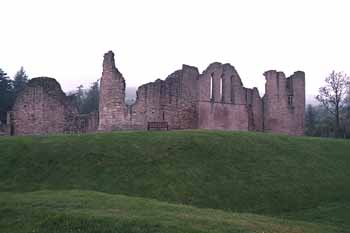
Ruins of Kildrummy
When the English marched against Kildrummy, the women were sent further north on their way to Orkney, under the protection of the Earl of Atholl. Neil defended Kildrummy admirably against the younger Edward. Unfortunately, he was betrayed from within by a blacksmith bribed with ‘all the gold he could carry’ to set fire to the grain stores. With no food, the men of Kildrummy were forced to surrender. Neil was captured, and in September 1306, hanged, drawn, and quartered at Berwick-on-Tweed. (The blacksmith, on being caught by the Scots, did indeed receive his reward for betraying the King’s brother: all the gold he could carry was melted and poured down his throat. I’m thinking he would have done better to remain gold-less but loyal.)
Neil (or Nigel) would have been about 30 at the time of his death. (The year or his birth is given as circa 1276, and so far in my research, without a month.)
The death of his brother Neil, the first of the five brothers to die at England’s hands, was a devastating blow to Bruce, both personally and in his quest to reclaim his country. The sickening feeling to all of them, Robert, Edward, Thomas, and Alexander, on hearing of the vicious torture, mutilation, and execution of their own brother, can only be imagined. Bruce, who, as the eldest brother, ultimately had made the decision for all of them, to fight, had known from the start that he risked bringing this on his own family. Of course, succumbing to Longshanks’ brutal rule was no guarantee of a long and peaceful life, either. In fact, knowing how Longshanks treated Scotland, it was a guarantee of the opposite. Still, the death of his brother, resulting from his decisions, is believed to have weighed heavily on Bruce’s heart.
One can imagine the thoughts of all the Bruce brothers, knowing any of them could be next. And, indeed, it was less than a year later–on February 9, 1307, that Thomas and Alexander would die at Carlisle the same way Neil had. During the winter months of 1306-1307, many believe Bruce and his company rested and re-grouped in the western islands under the hospitality and protection of Christina MacRuairi. It is from there that Bruce and his followers launched their two-pronged return to the mainland of Scotland in February 1307.
Robert and Edward landed at Turnberry Castle in the southwest, while Thomas and Alexander led 18 galleys in the landing further south still, at Loch Ryan. They were immediately overwhlemed by the local forces of Dougal MacDougal, a supporter of the Comyns. Keep in mind that Robert Bruce killed John Comyn at the altar of Greyfriars Kirk not quite a year prior to this, on February 10, 1306. Alexander would most likely have been short of his 22nd birthday, and Thomas short of his 23rd.
Thus, within six months, the English executed three of Bruce’s four brothers, leaving himself and the third of the five brothers, Edward. It is easy to imagine that they felt the executioner’s rope heavy around their own necks at that point. It is easy enough, reading history 700 years later, and knowing they would live for many years to come–especially Robert–but they did not have the comfort of such foreknowledge. They could only push on, most likely feeling that, with all their brothers so quickly captured and executed, the odds were heavily against them. Still, they did push on.
Edward Bruce comes down through history as forceful, hot-headed, and willful. Because he lived much longer, the historical record is full of stories of Edward Bruce. In brief, he fought beside Robert through the years leading up to Bannockburn, a loyal supporter and a thorn in his side. On the one hand, he re-captured many of the castles taken by Edward I. On the other, he made the rash agreement with Phillip de Mowbray, the English commander of Stirling Castle, which led to exactly the pitched, face to face battle with the English which Robert had always tried to avoid.
(Again, ask what if? What if Bruce had chosen Edward to lead the attack on Loch Ryan? I have not done the research to know if history tells us why Bruce chose as he did, but years of reading on Edward makes it easy to guess that he may have kept Edward at his side exactly to keep his rashness under control. What if the more level-headed Thomas or Alexander had survived and been sent to conduct the siege at Stirling? The Battle of Bannockburn likely never would have happened.
It was a huge, but unavoidable, risk at the time, once Edward Bruce opened his mouth and put Robert into that unenviable position. It is probably not completely possible for most of us to imagine marching to battle with a force three times the size of our own. But Robert was thrown into that position, and turned it into Scotland’s greatest moment. Does this make Edward Bruce the villain and fool of the story or the accidental hero? Or the full-blown hero for having the courage to face the largest army the world had ever seen?
Edward Bruce commanded the men of Galloway in one of four schiltrons (rings of spears, against which even knights on warhorses could not stand) at the Battle of Bannockburn, on June 23 and 24, 1314. After Bannockburn, Edward was among those who pushed for continued attacks on England, in order to force England to acknowledge Scotland once again as an independent nation and Robert Bruce as its rightful king.
To this end, Edward Bruce also pushed Robert to lead the Irish in rebelling against their English overlords. His argument was that a few thousand Scots, with the aid of the Irish who also disliked England’s rule, could harry England further, harassing them on so many fronts that they must finally give in to Scotland’s very minimal demands.
Due to Edward’s manipulations behind his back, Robert was somewhat forced to agree to Edward’s plan, and on May 26, 1315, Edward’s fleets landed in Ireland. In 1316, he was crowned King of Ireland. His brief reign ended with his death at the battle of Faughart on October 14, 1318. De Birmingham, the opposing commander, had his body quartered, and the pieces sent to various towns in Ireland. His head was delivered to Edward II.
He was about 39 years old. He left behind at least one son, Alexander de Brus, fathered with his probable wife, Isabelle, daughter of John de Strathbogie, Earl of Atholl. Records suggest an intended second marriage, after Isabelle’s death, to Isabella Ross, and a second son, Thomas, by this other Isabelle. Many historians doubt the marriage actually took place.
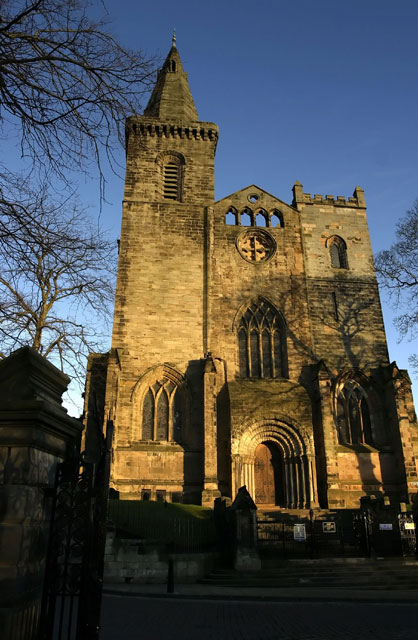 This left Robert, the eldest, as the sole survivor of his father’s five sons. He spent the rest of his years working to ensure Scotland’s freedom from England. He died on June 7, 1329, at the age of 54, at his new manor of Cardross. He had suffered for years from a painful skin ailment, that has been called everything from psoriasis to leprosy. He is buried at Dunfermline Abbey. At his request, however, James Douglas, his closest friend and companion, removed his heart, embalmed and enclosed it in a silver casket, and carried it to the Crusades, to atone for his murder of John Comyn 23 years earlier. James Douglas died in the Crusades, but the silver casket with Bruce’s heart was recovered and buried at Melrose Abbey.
 Tweet This Post


