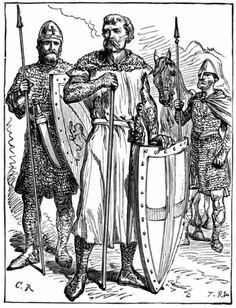
Central to Robert Bruce’s struggles, and Scotland’s Wars of Independence which form the backdrop of The Blue Bells Trilogy, is England’s claim to be overlords of Scotland.
Why Edward I claimed, in the late 1200′s, to be overlord of Scotland requires a trip back to 1174. (Fasten your seatbelts, our time machine is revving its engines!) David I is widely regarded as one of Scotland’s greatest kings. I will quote a historian who says it well: “‘He had found Scotland an isolated cluster of small half-united states, barely emergent from the Dark Ages; he left her a kingdom, prosperous, organised, in the full tide of medieval life, and fully part of Europe, as she remained through the rest of the middle ages and some time after.”
David’s son, Henry, died before David. He left three sons, two of whom became kings of Scotland. Malcolm IV reigned only twelve years and died without an heir. William the Lion, his younger brother, took the throne on December 9, 1165. In contrast to his brother, he was a strong king and a man of action. He is said to have been powerfully built, with red hair, and very headstrong. The title ‘the Lion,’ however, refers not to his strength or character, but to the fact that it is he who adopted the Lion Standard, the rearing red lion on a field of gold, which Robert the Bruce would carry 150 years later, and is still the royal standard of Scotland today.
One of William’s goals was to regain control of Northumberland, in the north of England. This had long-lasting consequences on Scotland’s future.
In the early years of his reign, he had something of a friendship with Henry II of England. He went to Normandy with him in 1166 and spent Easter 1170 as his guest. However, not entirely trusting Henry, he also joined an early incarnation of the Auld Alliance, a mutual pact of protection between Scotland, France, and Norway. When Henry’s three sons and wife, Eleanor of Aquitaine, revolted against him in 1173, William stepped into the conflict, agreeing to help Eleanor in exchange for Northumberland.
In a stunning display of over-confidence at the ensuing Battle of Alnwick (which castle is better known today as Hogwarts in the Harry Potter movies!), William single-handedly charged the English troops, shouting, “Now we shall see which of us are good knights.” Apparently, given the odds, the English were. They captured William, and led him in chains to Newcastle, Northampton, and finally, Falaise, in Normandy.
He remained a prisoner for five months, obtaining his release only by signing the Treaty of Falaise on December 8, 1174. The treaty stated that Scots would be taxed to pay the cost of the occupying English armies, England would control Edinburgh, Stirling, and other key castles, and, most importantly to the events that would follow more than a hundred years later, that William recognize Henry as his feudal overlord. In 1175, he swore fealty to Henry at York.
In 1189, Richard I became king and launched his Crusades. By the third, he needed money, and so, sold back to Scotland, for 10,000 silver marks, the rights signed away by the Treaty of Falaise. Thus, for 15 years, England’s king was the overlord of Scotland.
Jump back to the reign of Alexander III in the 1200′s. Alexander became king at the age of 8. Henry III, now king of England, saw an opportunity in the youth of Scotland’s new king. At age 10, Alexander married Henry’s daughter, Margaret, and Henry began pressuring Alexander to swear fealty to Henry and England. Alexander sidestepped the demands, until after Edward I succeeded Henry III, when, with carefully chosen words, he swore this: “I become your man for the lands I hold of you in the Kingdom of England for which I owe homage, saving my Kingdom.”
Edward did not give up dreams of being overlord, like Henry II. His opportunity came in 1290. Four years earlier, Alexander III had died in a fall over a cliff, while trying to get home to his bride. His granddaughter, Margaret, the Maid of Norway, was his only heir, but on her journey to Scotland to claim the throne, she, too, died, leaving Scotland a kingdom without a king.
Into the void stepped thirteen men claiming to be the rightful heir. Fearful of civil war, the Scottish nobles asked Edward to choose. Edward agreed on the stipulation that he be recognized as overlord. The Scots, not surprisingly, rejected his kind offer, saying that, as there was no king, no one in their realm had the authority to agree to such a thing. They countered with the offer that he could be overlord until he chose a king.
The real choice was between Robert the Bruce (the Competitor, grandfather of the Robert the Bruce) and John Balliol. While some believe that Balliol did indeed have the stronger claim to the throne, it is generally accepted that Edward chose him more because he regarded him as the weakest man, one whom he could control and thus effectively rule Scotland. Thus, even after Balliol was crowned on November 30, 1292, Edward continued to act as overlord. Balliol soon refused to comply, leading to his forced abdication on July 10, 1296.
At issue remained Edward’s claim to be overlord of Scotland, stemming from the days of William the Lion more than a century prior. The Scots of course objected strongly, and it is at this stage that William Wallace rose, fighting for Scotland’s freedom. After his death in August of 1305, Robert the Bruce (grandson of the Competitor) took the throne of Scotland (that story is told elsewhere in my blog). From his crowning in March 1306, he fought against the English armies that occupied his country, leading steadily to the Battle of Bannockburn in June, 1314, in which Bruce pitted his own small army against the might of England, an army two to three times the size of his own.
It is this battle, stemming from years of England’s claim to sovereignty over Scotland, for which Niall, in Blue Bells of Scotland, is meant to make his cross-country trip to raise men, and this situation into which Shawn inadvertently wakes up, finding himself making the mission in Niall’s place.
Sources: Electric Scotland, Undiscovered Scotland, BritRoyals, and more.
Nesa (the Ness); and when he reached the bank of the river, he saw some of the inhabitants burying an unfortunate man, who, according to the account of those who were burying him, was a short time before seized, as he was swimming, and bitten most severely by a monster that lived in the water; his wretched body was, though too late, taken out with a hook, by those who came to his assistance in a boat. The blessed man, on hearing this, was so far from being dismayed, that he directed one of his companions to swim over and row across the coble that was moored at the farther bank. And Lugne Mocumin hearing the command of the excellent man, obeyed without the least delay, taking off all his clothes, except his tunic, and leaping into the water. But the monster, which, so far from being satiated, was only roused for more prey, was lying at the bottom of the stream, and when it felt the water disturbed above by the man swimming, suddenly rushed out, and, giving an awful roar, darted after him, with its mouth wide open, as the man swam in the middle of the stream. Then the blessed man observing this, raised his holy hand, while all the rest, brethren as well as strangers, were stupefied with terror, and, invoking the name of God, formed the saving sign of the cross in the air, and commanded the ferocious monster, saying, “Thou shalt go no further, nor touch the man; go back with all speed.” Then at the voice of the saint, the monster was terrified, and fled… And even the barbarous heathens, who were present, were forced by the greatness of this miracle, which they themselves had seen, to magnify the God of the Christians.
Therefore it is, Reverend Father and Lord, that we beseech your Holiness with our most earnest prayers and suppliant hearts, inasmuch as you will in your sincerity and goodness consider all this, that, since with Him Whose vice-gerent on earth you are there is neither weighing nor distinction of Jew and Greek, Scotsman or Englishman, you will look with the eyes of a father on the troubles and privation brought by the English upon us and upon the Church of God. May it please you to admonish and exhort the King of the English, who ought to be satisfied with what belongs to him since England used once to be enough for seven kings or more, to leave us Scots in peace, who live in this poor little Scotland, beyond which there is no dwelling-place at all, and covet nothing but our own. We are sincerely willing to do anything for him, having regard to our condition, that we can, to win peace for ourselves. This truly concerns you, Holy Father, since you see the savagery of the heathen raging against the Christians, as the sins of Christians have indeed deserved, and the frontiers of Christendom being pressed inward every day; and how much it will tarnish your Holiness’s memory if (which God forbid) the Church suffers eclipse or scandal in any branch of it during your time, you must perceive. Then rouse the Christian princes who for false reasons pretend that they cannot go to help of the Holy Land because of wars they have on hand with their neighbours. The real reason that prevents them is that in making war on their smaller neighbours they find quicker profit and weaker resistance. But how cheerfully our Lord the King and we too would go there if the King of the English would leave us in peace, He from Whom nothing is hidden well knows; and we profess and declare it to you as the Vicar of Christ and to all Christendom. But if your Holiness puts too much faith in the tales the English tell and will not give sincere belief to all this, nor refrain from favouring them to our prejudice, then the slaughter of bodies, the perdition of souls, and all the other misfortunes that will follow, inflicted by them on us and by us on them, will, we believe, be surely laid by the Most High to your charge.


In his last written requests as he lay dying at Cardross, on May 13, 1329, Bruce asked that his heart be buried at Melrose Abbey. Does his request have anything to do with the fact that his own father was buried at Holm Coultram, a daughter house of Melrose, in England? After Bruce’s death, as per another request, Bruce’s heart made a brief trip to Spain to fight the Crusades, embalmed in a silver casket. On its return, it was buried at Melrose as requested.

This left Robert, the eldest, as the sole survivor of his father’s five sons. He spent the rest of his years working to ensure Scotland’s freedom from England. He died on June 7, 1329, at the age of 54, at his new manor of Cardross. He had suffered for years from a painful skin ailment, that has been called everything from psoriasis to leprosy. He is buried at Dunfermline Abbey. At his request, however, James Douglas, his closest friend and companion, removed his heart, embalmed and enclosed it in a silver casket, and carried it to the Crusades, to atone for his murder of John Comyn 23 years earlier. James Douglas died in the Crusades, but the silver casket with Bruce’s heart was recovered and buried at Melrose Abbey.