Posts Tagged ‘St. Columba’

A friend of mine once said she loved her Catholic faith because ‘it has all the cool stuff.’  She was talking about the many mystical and miraculous events throughout Catholic history and the lives of the Saints.  St. Columba, 521-597, definitely falls into the category of mystical and miraculous.  His life story contains at least a hundred miracles: walking on water, raising the dead, driving out serpents, controlling wind and storms, purifying springs, prophesying the future as well as ‘seeing’ current but distant events.  In an event that could only take place in Scotland, he is credited with being the first recorded observer of the Loch Ness monster.

… when the blessed man was living for some days in the province of the Picts, he was obliged to cross the river Nesa (the Ness); and when he reached the bank of the river, he saw some of the inhabitants burying an unfortunate man, who, according to the account of those who were burying him, was a short time before seized, as he was swimming, and bitten most severely by a monster that lived in the water; his wretched body was, though too late, taken out with a hook, by those who came to his assistance in a boat. The blessed man, on hearing this, was so far from being dismayed, that he directed one of his companions to swim over and row across the coble that was moored at the farther bank. And Lugne Mocumin hearing the command of the excellent man, obeyed without the least delay, taking off all his clothes, except his tunic, and leaping into the water. But the monster, which, so far from being satiated, was only roused for more prey, was lying at the bottom of the stream, and when it felt the water disturbed above by the man swimming, suddenly rushed out, and, giving an awful roar, darted after him, with its mouth wide open, as the man swam in the middle of the stream. Then the blessed man observing this, raised his holy hand, while all the rest, brethren as well as strangers, were stupefied with terror, and, invoking the name of God, formed the saving sign of the cross in the air, and commanded the ferocious monster, saying, “Thou shalt go no further, nor touch the man; go back with all speed.” Then at the voice of the saint, the monster was terrified, and fled… And even the barbarous heathens, who were present, were forced by the greatness of this miracle, which they themselves had seen, to magnify the God of the Christians.

Columba hailed from Ireland, a royal descendant of Niall of the Nine Hostages.  After a basic education, he entered a monastic school under the tutorship of St. Finian, who had studied in Galloway with St. Ninian.  Even as a student at Moville, he began performing miracles.  One was turning water into wine for the Mass.  He spent fifteen years in Ireland, setting up religious houses in Derry, Durrow, and Kells.

Writing of St. Columba in the Cathac

In his early 40′s, Columba made his move to Scotland.  Some sources attribute this to King Dermot disliking Columba’s zeal against public vices.  More often, it is linked to a family feud that ended with the death of 3,000 men, and for which Columba felt some responsibility.  Still other stories concern a judgement made against Columba for making a secret copy of St. Finian’s psalter.  And some versions state that the battle was, in fact, the result of the dispute over copying the book.  The Cathac, or Book of the Battle, the book of Psalms copied by Columba in the 6th century, still exists today, after a long and interesting history, and is preserved by the Royal Irish Academy.  

The earliest sources, those closest to Columba’s own time, do not mention the book or battle as Columba’s reason for leaving, but simply ascribe to him the desire to win souls for God, and this reason is accepted by some. 

Whatever the reasons, Columba established himself and his followers on the island of Iona, founded a monastic rule that was followed until St. Benedict, and from Iona, set about converting, or in cases re-converting, Scotland. 

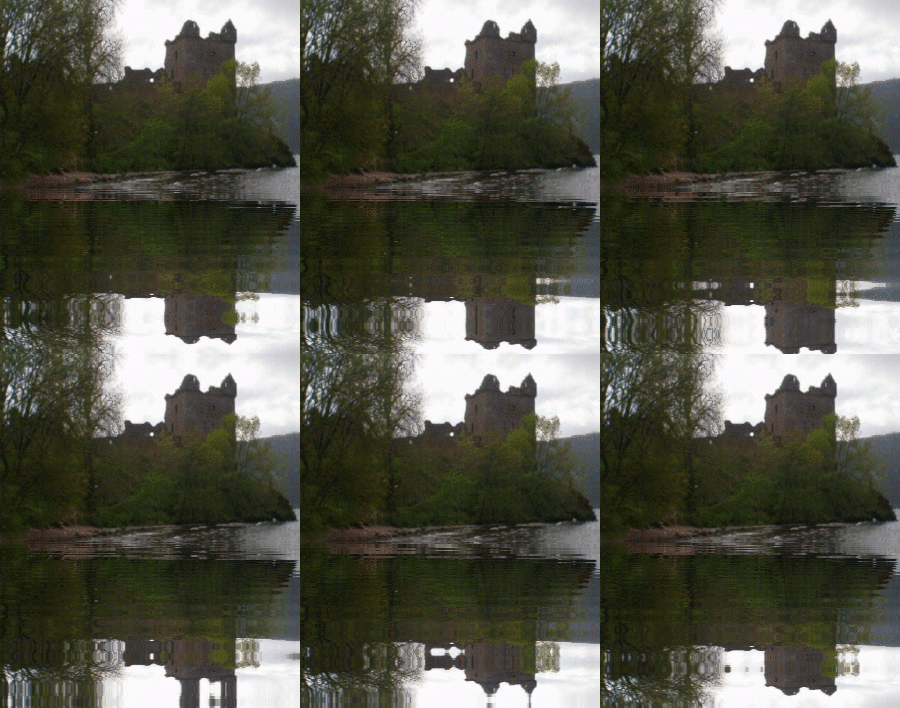
Among his most famous encounters is that with the Pictish chief, Brude, who is thought to have lived where Urqhart Castle now stands, on the north shore of Loch Ness.  Brude, having no desire to meet with Columba, or Saints Comgall or Canice who traveled with him, closed and locked the gates.  Columba lifted his hand and made the sign of the cross, at which point the bolts holding the gates fell away.  The three saints walked into the castle unhindered.  Brude stood in awe of the miracle.  He not only listened to the Saints, but was baptized by them.  His people soon followed, and much of Caledonia was converted.

Columba lived austerely, sleeping on floors and using stones for pillows.  At least one of those stones is today credited with miraculous powers.  Despite his austerity, he was cheerful, joyful, mild-mannered, and charitable in his thoughts and dealings with others.  Yet he also commanded great authority, such that even kings consulted with him before acting.  

Columba lived into his 70′s, spending his time traveling around Scotland, and occasionally back to Ireland.  He primarily spent his last years, however, on Iona.  In the summer of 597–or 592 according to the Annals of the Four Masters, the discrepancy in years possibly being due to the change in calendars–Columba was already regarded as a saint.  He knew his death was approaching, and climbed the hill above the monastery to give it one last blessing.  He returned to his cell to continue transcribing a psalter, and died there in the earliest hours of Sunday, June 9.

The full text of Adaman’s Life of St. Columba can be read online, detailing Columba’s life and many more miracles and prophecies.

For some background information on this article, it is important to know that Bruce lived from 1274 until 1329,  200 years before Martin Luther’s 95 Theses and before Henry VIII made his split from the Catholic Church.  In other words, in his day to be Christian was to be Catholic.

And Bruce himself seems to have been a rather devout Catholic.  He counted among his close friends and associates Bishops Lamberton and Wishart, and Bernard de Linton, Abbot of Arbroath.  He carried the relics of both St. Columba and St. Fillan to the Battle of Bannockburn in June of 1314.   And on the morning of the main battle, Bruce started the day with Mass, his army of thousands on its knees before Maurice, the blind and barefoot abbot of Inchaffray, not only saying Mass, but receiving absolution.  The Declaration of Arbroath, sent to the Pope in 1320, compares Bruce to the Biblical figures of Joshua and Judas Maccabeus, who led their people against oppressors.  One of his unfulfilled dreams was to go on a Crusade.  Such was his wish that, though he was unable to fulfill it himself, he exhorted a promise from his closest friend, James Douglas, that, after Bruce’s death, James would take his, Bruce’s, heart on Crusade.  This James Douglas did, carrying Bruce’s heart in a silver casket. 

As to excommunication, it is a formal declaration of exclusion from the community, and within the Catholic Church typically means one is no longer allowed to partake of communion. 

For a devout Catholic, Robert Bruce had a bad knack for getting ex-communicated.  It started with the murder of John Comyn, the Red Comyn, Lord of Badenoch (yes, these were all the same man– just to be clear which of several John Comyns we’re talking about) before the altar of Greyfriars Church in 1306.  In Blue Bells of Scotland, Shawn expresses disbelief that a man should be excommunicated for killing, as it seems, to him, to be the national pastime of medieval Scotland.  And it is true that the real issue was not so much the killing, as the killing of a man on holy ground.

The thing to remember about excommunication is that it’s like drenched.  You can’t get more drenched, and you can’t get more excommunicated.  Unlike drenchings, though, excommunication does not ‘dry out.’  You remain so until it is formally lifted.  And this is why it’s an almost amusing story, that in 1317, with the former excommunication never having been lifted, and no more severe penalties to inflict, Pope John XXII once again excommunicated Bruce.  This time, however, he applied the punishment to all of Bruce’s associates, the whole of Scotland, really, and furthermore, declared that the prelates of York and London were to repeat the excommunication ceremony every single Sunday and every holy day for a whole year.  As if a drenched man might become even more drenched.

Interestingly, many sources credit the Pope’s ridiculous order as the inspiration for the Scottish nobles writing the Declaration of Arbroath, Scotland’s most famous document on a par with, and many say largely the basis for, our own Declaration of Independence. 

I wonder how Bruce or his comrades felt about all of this.  I suspect that they were strong enough in their faith in the rightness of their cause, declaring the independence that had always been theirs before Edward Longshanks invaded,  that it was little more than a source of amusement to them, although I would think it might also have saddened them, to be on the wrong side of a faith and church that they obviously valued.